
What You Need to Know
Building a powerful physique requires a meticulous balance of calorie manipulation, structured macronutrients, and strategic food selection rather than relying on guesswork.
- Bulking phases require an approximate 15% increase over maintenance calories to support muscle hypertrophy, while cutting phases demand a 15% decrease to stimulate fat loss.
- The ideal macronutrient split consists of 30% to 35% protein, 55% to 60% carbohydrates, and 15% to 20% dietary fats.
- Weekly weight change should remain between 0.5% and 1.0% of total body weight to prevent excessive fat gain or muscle loss.
- According to guidelines verified in 2026 by the International Society of Sports Nutrition (ISSN), spreading protein intake across multiple high-quality meals maximizes muscle protein synthesis.
Your individual metabolic rate and current body composition are the primary variables that dictate your exact caloric requirements.
Determining Your Daily Calorie Needs
The foundation of any successful bodybuilding diet guide rests on understanding daily energy expenditure. To establish your baseline, track your food intake and weigh yourself at least three times a week for 14 days. If your body weight remains stable, this average number represents your maintenance calories.
Calorie Surplus for Bulking (Muscle Gain)
Once you establish your maintenance level, increase your calorie intake by 15% to initiate a clean bulking phase. For example, if your maintenance is 3,000 calories, your target becomes 3,450 calories daily. This surplus provides the extra energy required to synthesize new muscle tissue efficiently.
Avoid larger calorie spikes, as they often lead to excessive body fat accumulation. Your progress should be slow and steady, targeting a weight gain of 0.5% to 1.0% of your body weight per week.
Calorie Deficit for Cutting (Fat Loss)
To transition into a cutting phase, reduce your maintenance calories by 15%. For a person with a 3,000-calorie maintenance level, this reduces daily intake to 2,550 calories. This structured deficit forces the body to burn stored fat while sparing hard-earned muscle mass.
Revisit your caloric calculations every month to account for changes in your total body mass. Restricting calories too aggressively can result in metabolic adaptation and muscle loss.
Ideal Macronutrient Ratios for Weightlifters
To achieve optimal results, maintain a consistent macronutrient ratio during both bulking and cutting phases. While the physical quantity of food fluctuates, the percentage-based breakdown remains steady. The following table illustrates how these ratios translate into daily grams for both phases.
| Macronutrient | Percentage of Total Calories | Bulking Phase (3,450 kcal) | Cutting Phase (2,550 kcal) |
|---|---|---|---|
| Protein | 30% to 35% | 259g to 302g | 191g to 223g |
| Carbohydrates | 55% to 60% | 474g to 518g | 351g to 383g |
| Dietary Fats | 15% to 20% | 58g to 77g | 43g to 57g |
Protein: The Muscle-Building Block
Protein contains 4 calories per gram and provides the essential amino acids required for repairing muscle fibers damaged during training. The French National Agency for Food, Environmental and Occupational Health Safety (ANSES) recommends a baseline protein intake for active individuals, which strength athletes scale up to match their high-intensity training. Aiming for 1.6 to 2.2 grams of protein per kilogram of body weight is standard in amateur and elite bodybuilding.
Carbohydrates: Fueling Your Training
Carbohydrates provide 4 calories per gram and serve as the primary energy source for high-intensity weightlifting. They replenish muscle glycogen stores, which directly impacts training performance and muscular endurance. Restricting carbohydrates too severely can compromise your strength training diet and limit overall muscle growth.
Dietary Fats: Hormone Regulation and Health
Dietary fats deliver 9 calories per gram and are vital for supporting joint health and hormone production, particularly testosterone. Restricting fats below 15% of daily calories can disrupt hormonal balance and impair recovery. Focus on unsaturated fats to support long-term cardiovascular health.
Foods to Prioritize for Muscle Growth and Recovery
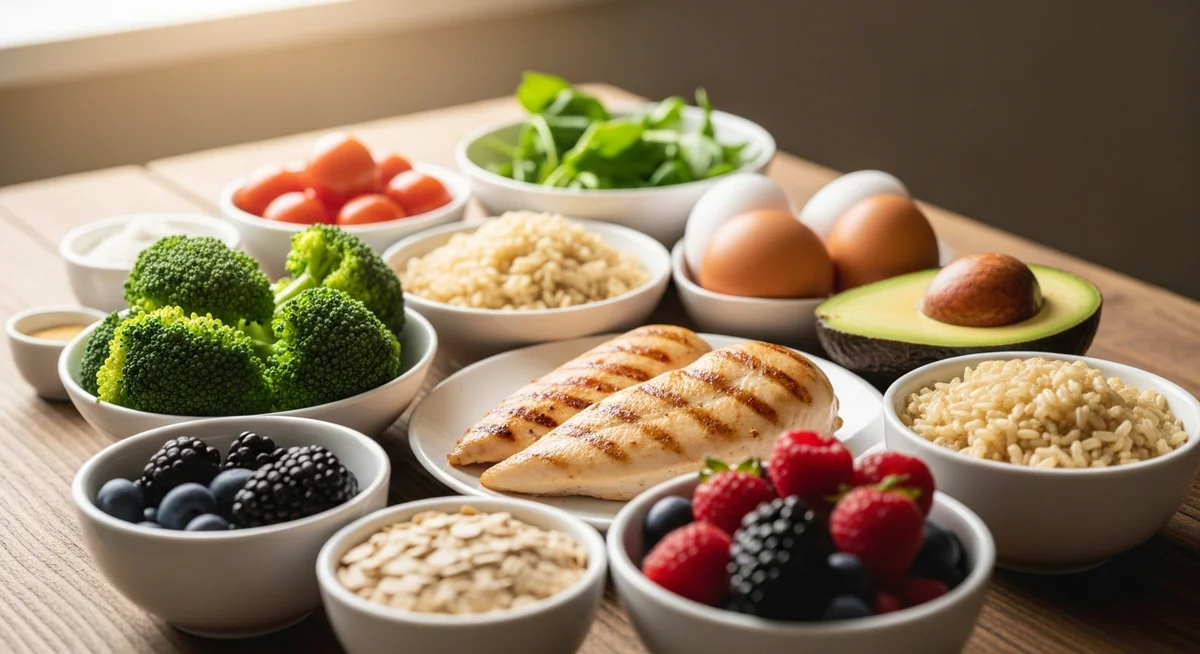
Your nutrition for muscle growth should rely on whole, nutrient-dense foods that deliver vitamins, minerals, and clean energy. Vary your choices to avoid micronutrient deficiencies during restricted cutting phases.
- Lean proteins: Sirloin steak, flank steak, chicken breast, turkey breast, salmon, cod, eggs, and egg whites.
- High-quality dairy: Low-fat Greek yogurt, cottage cheese, and skim milk.
- Complex carbohydrates: Oatmeal, quinoa, brown rice, jasmine rice, sweet potatoes, and whole-wheat bread.
- Fibrous vegetables: Broccoli, spinach, asparagus, Brussels sprouts, green beans, and bell peppers.
- Healthy fats: Extra virgin olive oil, avocados, almonds, walnuts, chia seeds, and natural peanut butter.
Foods to Limit or Avoid
Achieving a lean, muscular physique requires avoiding foods that provide empty calories or trigger inflammation.
Alcohol should be strictly limited as it impairs muscle protein synthesis, reduces sleep quality, and slows down overall recovery. It also adds empty calories that can easily derail a weightlifting meal plan.
Added sugars from candy, soda, and pastries offer immediate energy spikes but lack the nutrients required to sustain high-intensity workouts. They also lead to rapid fluctuations in blood glucose levels.
Deep-fried foods can promote systemic inflammation and delay digestion, causing gastrointestinal distress if consumed close to your workout session. Focus on baking, grilling, or air-frying your meals instead.
Key Supplements for Weightlifters
Supplements are designed to complement, not replace, a structured weightlifting meal plan. Always consult a certified sports nutritionist or sports physician before starting a new regimen.
- Whey Protein: Provides a fast-digesting source of essential amino acids immediately post-workout.
- Creatine Monohydrate: Enhances adenosine triphosphate (ATP) production, increasing power output and muscle volume during heavy sets.
- Caffeine: Improves focus and reduces the perception of effort when consumed 30 to 60 minutes before training.
- Beta-Alanine: Acts as an intracellular buffer to delay muscle fatigue during high-repetition sets.
A Sample 7-Day Bodybuilding Diet Guide
This sample plan is designed for an active individual requiring approximately 3,000 calories per day. You can scale the portion sizes up or down based on your personal daily target.
Monday
- Breakfast: 100g oatmeal with 1 scoop of whey protein and 30g almonds.
- Lunch: 200g chicken breast with 150g cooked jasmine rice and 100g steamed broccoli.
- Snack: 200g Greek yogurt with 50g blueberries and 15g chia seeds.
- Dinner: 200g lean beef sirloin with 250g baked sweet potato and a mixed green salad.
Tuesday
- Breakfast: 4 whole scrambled eggs, 2 slices of whole-wheat toast, and 1 banana.
- Lunch: 200g canned tuna mixed with 15g light mayonnaise, wrapped in 2 large flour tortillas.
- Snack: 1 scoop of whey protein mixed with 300ml skim milk and 1 apple.
- Dinner: 200g salmon fillet with 150g quinoa and 100g grilled asparagus.
Wednesday
- Breakfast: 100g cream of rice, 1 scoop of whey protein, and 100g sliced strawberries.
- Lunch: 200g turkey breast with 150g cooked basmati rice and 100g green beans.
- Snack: 250g low-fat cottage cheese with 30g walnuts.
- Dinner: 200g cod fillet, 250g mashed white potatoes, and 100g steamed zucchini.
Thursday
- Breakfast: 3 whole eggs, 100g liquid egg whites, and 100g cooked spinach on whole-wheat bread.
- Lunch: 200g chicken breast, 150g cooked wild rice, and 100g roasted Brussels sprouts.
- Snack: Rice cakes with 30g natural peanut butter and 1 scoop of whey protein.
- Dinner: 200g pork tenderloin, 250g roasted red potatoes, and a mixed side salad with olive oil.
Friday
- Breakfast: 100g oatmeal, 4 boiled egg whites, 1 whole egg, and 50g raspberries.
- Lunch: 200g lean ground beef, 150g cooked brown rice, and 100g bell peppers.
- Snack: 200g Greek yogurt with 15g honey and 30g sliced almonds.
- Dinner: 200g tilapia fillet, 150g cooked quinoa, and 100g steamed broccoli.
Saturday
- Breakfast: Protein pancakes made with 100g oat flour, 1 scoop of whey protein, and 2 egg whites.
- Lunch: 200g turkey breast, 150g cooked jasmine rice, and 100g green peas.
- Snack: 250g cottage cheese with 100g pineapple chunks.
- Dinner: 200g flank steak, 250g baked sweet potato fries, and 100g grilled zucchini.
Sunday
- Breakfast: 4 scrambled eggs, 2 slices of rye toast, and 1 orange.
- Lunch: 200g salmon fillet, 150g cooked basmati rice, and 100g steamed asparagus.
- Snack: 1 scoop of whey protein shake with 1 banana and 20g peanut butter.
- Dinner: 200g chicken breast, 250g baked white potato, and 100g steamed spinach.
Nutrient Timing: When to Eat for Maximum Performance
Properly distributing your meals throughout the day optimizes energy levels and muscle recovery.
- Pre-workout nutrition: Consume a meal containing 30g to 40g of protein and 50g to 80g of slow-digesting carbohydrates roughly 2 to 3 hours before your training session.
- Intra-workout hydration: Drink plenty of water during your workout; adding essential amino acids can help if your session extends past 60 minutes.
- Post-workout recovery: Eat a meal containing high-quality protein and fast-acting carbohydrates within 1 to 2 hours after training to kickstart muscle repair.
- Before sleep: Consume a slow-digesting protein like micellar casein or cottage cheese to provide a steady release of amino acids overnight.
Potential Risks and Considerations
While structured eating is highly beneficial, bodybuilding diets carry risks if implemented without proper balance and caution.
- Micronutrient deficiencies: Restricting food variety during a cutting phase can lead to low levels of essential vitamins and minerals, particularly zinc and magnesium.
- Gastrointestinal distress: Consuming excessively high amounts of fiber or eating heavy meals too close to training can disrupt digestion.
- Disordered eating patterns: Rigidly tracking every single gram of food can lead to psychological strain or social isolation.
- Renal and metabolic strain: Extremely high protein intakes combined with inadequate hydration can place unnecessary stress on the kidneys.